
Document verification, automated
One figure out of line,
days stuck at the port.
ClearBerth cross-checks your packing list, House B/L, Master B/L, invoice and EUR.1, and finds the discrepancy that would hold you at customs — before the container leaves. A stamped report in one minute.
The demo
42 seconds to get it
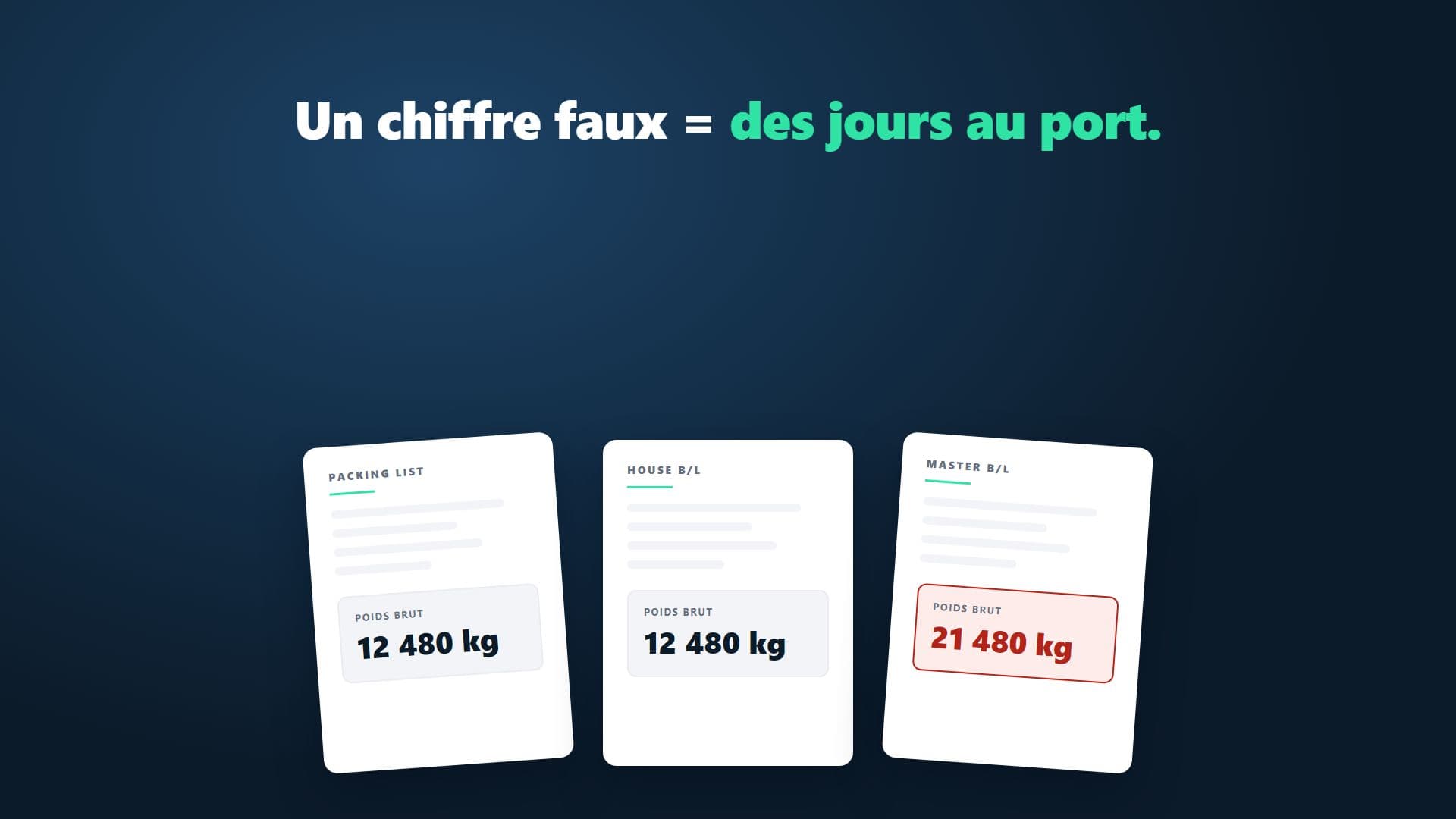
One figure that differs between documents, and the container waits at the port. Here is how ClearBerth catches it before customs does.
How it works
From inbox to stamp,
in three moves
Upload the documents
Drag the files straight from your mail client or your file explorer — packing lists, B/Ls, invoice, EUR.1. Several files per category, PDF or Excel, scans included.
ClearBerth cross-checks
Every format is read automatically, every value is checked word for word against the source document, totals are recalculated independently, 40+ cross-checks.
Handle, stamp
Each discrepancy is a finding you clear in one click. All settled? The shipment turns COMPLIANT — stamped, dated, signed by name, ready for customs.
The report
Every discrepancy has
a colour and a next move
The comparison puts the three documents side by side. A red row blocks, an amber one needs checking, a green one matches — click the row, handle the finding, it turns green. Nothing closes on a doubt: when a value is missing, ClearBerth says so.
- ✓Container number + ISO 6346 check digit, seal matched
- ✓Gross and net weights with tolerances, sums of line items
- ✓Packages compared in like units (pallets vs cartons)
- ✓Tax ID, shipper, consignee, ports, country of origin
- ✓EUR.1 checked against the documents — flagged if an EU import has none
- ✓DRAFT documents detected and compared with the final version
What it catches
The mistakes a tired eye
lets through
Four families of real mistakes, met on real shipments. Each one would have held a container — each one became a permanent check.
The disguised draft
document.draftA provisional B/L whose DRAFT marking exists only as a watermark painted into the image — invisible in the PDF text. Caught anyway: the shipment waits for the final document instead of leaving on a worthless transport document.
The doubled weight
bl.copiesThe same Sea Waybill uploaded twice (the original and its “_2.pdf” copy). Adding both means declaring 18 tonnes instead of 9. ClearBerth recognises it is the same document and counts it once.
House and Master swapped
documents.swapTwo bills of lading filed in the wrong slots: a shipping-line prefix on one, FIATA markings on the other, an issuer chain that makes no sense. The swap comes out as blocking — otherwise customs would have found it.
The digit lost in the scan
commercial.iceOn a poor scan, a 15-digit tax ID reads as 14 — a zero swallowed in the middle. Rather than use a wrong number, the value is set aside and marked to check, with the offending document pointed out.
Illustrative data, entirely fictitious. Every case met in production adds a check to the engine — it never gets caught twice.
Several documents
Three packing lists? Two House B/Ls? ClearBerth consolidates the totals and flags any contradiction inside a category.
Customs & EUR.1
The certificate of origin is checked against weights, packages, exporter and destination. An EU import with no EUR.1 is flagged — the tariff preference is worth real money.
Customers detected
The real importer is identified from the documents: the shipment files itself under the right customer, with its supplier and tax ID.
Nothing invented
Every extracted value must exist in the document, word for word. What is not there is marked Missing — never guessed.

A document error found at the port is paid for in demurrage days and storage fees — often more than the freight itself. ClearBerth finds it before the container leaves.
The house rule
The agent keeps
the stamp
ClearBerth never approves a shipment on your behalf. It puts every discrepancy in front of you, with both documents' values side by side — and you are the one who stamps, by name. Your judgement stays the final signature.
No fire alarm
Alerts that are
worth reading
A tool that cries wolf ends up ignored. Every check is calibrated on real shipments to block only what would block at customs: a spelling difference between two carrier names does not carry the weight of a divergent tonnage.
Pricing
Every feature,
at every volume
Unlimited users, free re-runs. Start with 5 shipments on us, no card required.
Starter
For a new agency or a branch office.
Pro
For the forwarder handling shipments every day.
Business
For high volumes and large teams.
Prices in euros, excluding taxes. No commitment: the monthly plan can be cancelled at the end of the current month.
Resources
Guides and a free tool
Free tool: container number check
Validate the ISO 6346 check digit of one or more container numbers, with the calculation shown step by step.
Try the tool →House B/L vs Master B/L: the difference, and what to check between them
Who issues the House B/L and the Master B/L, who appears as shipper and consignee, what must match between the two and what may legitimately differ.
Read →Checking shipping documents before customs clearance: the 10-point checklist
The 10 inconsistencies to look for across packing list, House B/L, Master B/L, invoice and certificate of origin before lodging a customs declaration.
Read →EUR.1 certificate: what to check before claiming the tariff preference
The EUR.1 movement certificate box by box: original or copy, customs endorsement, and the details to reconcile with the invoice and bills of lading.
Read →Frequently asked
What people ask us
What exactly does ClearBerth check?+
ClearBerth cross-checks more than 40 points across a shipment's documents: container number (ISO 6346 check digit), seal, gross and net weights, package counts, sums of line items, parties (shipper, consignee, tax ID), ports, the EUR.1 certificate against the transport documents, DRAFT detection and LCL/FCL rules.
Which documents and formats are accepted?+
Packing lists in Excel or PDF (including scans, read by character recognition), House B/L, Master B/L or Sea Waybill, commercial invoices and EUR.1 certificates. Several files per category are accepted and consolidated automatically.
Can I trust the values in the report?+
Yes. Every value in the report is checked word for word against the source document, and spreadsheet totals are recalculated independently. In case of doubt, ClearBerth asks for a manual check rather than deciding for you.
What if my documents are poor-quality scans?+
Scans are read and then cross-checked against every other source in the shipment. When a figure stays uncertain — a truncated identifier, an unreadable unit — it is never used as is: the value is marked “to check” and the report shows you exactly where to look. A poor scan slows the reading down; it does not distort the verdict.
How long does a check take?+
About a minute after you click “Run the analysis”. The report appears on its own, with a COMPLIANT, TO CHECK or REJECTED stamp and the list of findings to handle.
Which languages does ClearBerth work in?+
The portal and the report exist in French and English, and the report language is set per account: you can work in French and hand an English report to your customs broker. The documents themselves are read in French, English, Spanish, Turkish and other languages.
Where is my data hosted?+
Your documents and your database are hosted in Ireland, the server that processes them is in Germany, and scanned documents are read in France. The full list of our providers, with the country of each, is in our privacy policy: we ask no one to take our word for it.
Is my data used to improve your product?+
No. Your documents are used only to produce your reports. They are never reused to train or improve any system, never resold, and never accessible to another customer.
Who can see my shipments?+
You, and the colleagues you invite with the role you give them. Separation between customer accounts is not a statement of intent: it is verified by an audit that genuinely attempts to read and write from one account into another, then checks in the database that nothing was written.
Can I retrieve or erase my data?+
Yes, on request. We hand you all of your data in a usable format — shipments, uploaded documents and reports as files — and we can erase everything permanently. When a contract ends, your data is deleted at the latest twelve months later.
Why is there no cookie banner?+
Because there is nothing to accept. ClearBerth sets only two strictly necessary cookies: the one that keeps you signed in, and the one that remembers your language. No advertising cookies, no audience measurement, no third-party trackers.
The next shipment
leaves clean.
Create a shipment, drop in the documents, run the analysis. The stamp does the rest.
5 shipments on us · no card required · unlimited users